

Music Lessons for Focus and Brain Development
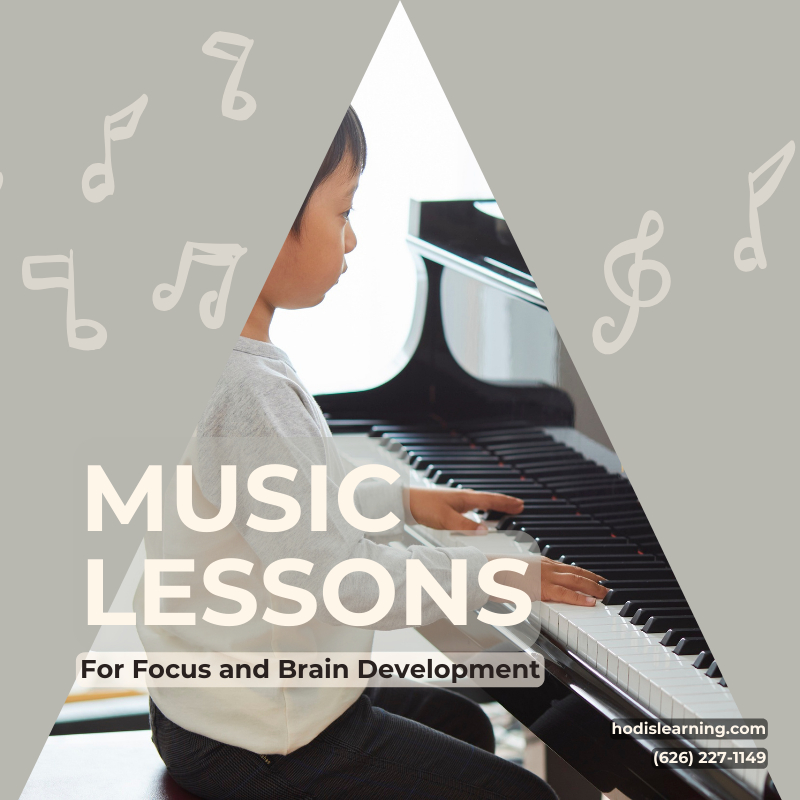
Music is often thought of as simply a creative pursuit—an expressive outlet, a skill, or even a welcome break from more academic demands. And while it is all of these things, learning music also engages the brain in ways that go far beyond creativity alone.
From the earliest stages of instruction through more advanced study, music lessons activate systems responsible for focus, memory, and self-regulation, helping students build cognitive skills that extend well beyond the practice room.
Music as a Workout for the Brain
When you play an instrument, multiple brain systems are activated simultaneously. You are reading notation, listening for accuracy, controlling fine motor movements, and anticipating what comes next.
This level of coordination encourages strong communication between different areas of the brain. Over time, this repeated “cross-training” helps the brain become more efficient at managing complex tasks, which is a foundational component of focus.
To break it down, music students are practicing how to sustain attention, ignore distractions, and shift focus when needed. These are skills that carry over into schoolwork and everyday life.
Focus, Attention, and Executive Function
One of the most noticeable benefits of music lessons is their impact on executive function. Executive function includes skills like planning, impulse control, working memory, and sustained attention. These are the skills students rely on to complete assignments, follow multi-step instructions, and manage their time effectively.
Music lessons naturally reinforce these abilities. A student must focus on small details (like rhythm or finger placement) while keeping the larger structure of the piece in mind. They learn to slow down, isolate challenges, and persist through mistakes.
Regular music practice also strengthens attention span. Even short, consistent practice sessions teach students how to stay mentally engaged, monitor performance, and make adjustments in real time.
Memory and Pattern Recognition
Music is deeply connected to memory. Students memorize notes, rhythms, and physical movements, often across long pieces of music. This strengthens both short-term and long-term memory systems.
Beyond memorization, music sharpens pattern recognition. Scales, chord progressions, rhythmic motifs, and musical forms all follow patterns. As students learn to recognize and predict these patterns, they are exercising the brain’s ability to organize and interpret information efficiently.
Pattern recognition is a transferable skill. It supports mathematical reasoning, language processing, and reading comprehension. In this way, music lessons also support broader cognitive development.
Emotional Regulation & Resilience
Focus isn’t just a cognitive skill; it’s also emotional. Students need to manage frustration, anxiety, and self-doubt in order to stay engaged with challenging tasks. Music lessons provide a safe and constructive space to develop this emotional regulation.
When students encounter difficult passages, they learn that progress comes through patience and problem-solving. Over time, this builds resilience and mental stamina.
Music also offers an emotional outlet. Playing an instrument can help students process feelings and reduce stress, which in turn supports clearer thinking and better concentration in other areas of life.
Why Consistency and Instruction Matter
While casual exposure to music is beneficial, structured music lessons make a significant difference in:
- Helping students learn how to practice effectively
- Setting goals
- Reflecting on progress
This intentional approach strengthens the brain systems responsible for self-directed learning.
Keep in mind that consistency is key. The benefits of music on focus and brain development grow over time through regular engagement. Weekly lessons and regular practice can lead to meaningful cognitive gains when sustained over months and years.
These benefits are not limited to young children. Teens and adults also experience improvements in attention, memory, and mental flexibility through music study.
Ready to Build Focus Through Music?
If you’re interested in music lessons that support focus, brain development, and a lifelong love of learning, Hodis Learning & Music is here to help! Contact us today by calling (626) 227-1149 or submitting a contact form to learn more.


Trackbacks & Pingbacks
[…] challenges both short-term and long-term memory. Students memorize notes, fingerings, dynamics, and entire pieces. They learn to anticipate what […]
Comments are closed.